Showing posts with label education. Show all posts

Saturday, October 4, 2014

10 Things Experienced Teachers Want New Teachers to Know

The first day of school is nerve-wracking for students — but it's even scarier for new teachers.
When you're facing a whole room full of bright-eyed students whose future is in your hands, it's an empowering and totally terrifying feeling. Like any practice, it takes time and experience to learn your way around the classroom. But that doesn't mean you can't benefit from a few words of wisdom from experienced colleagues.
A few seasoned teachers at Math for America provided tips that first-time educators should know. But even seasoned teachers could benefit from these pieces of advice.

Tuesday, April 2, 2013

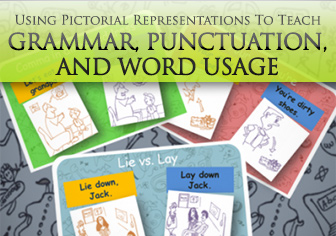
Using Pictorial Representations To Teach Rules Of Grammar, Punctuation, And Word Usage


Amused by the misplaced modifiers in your students’ writing? Frustrated that your students omit commas in direct address? Tired of explaining the difference between your and you’re to your students?

Try explaining these often-confused rules of grammar, punctuation, and word usage through pictorial representations. In this article I have shown how five tricky concepts can be explained pictorially. I have tried them and they work!

How to Teach Rules Of Grammar, Punctuation, And Word Usage Using Pictorial Representations

  1. 1

    Misplaced Modifiers

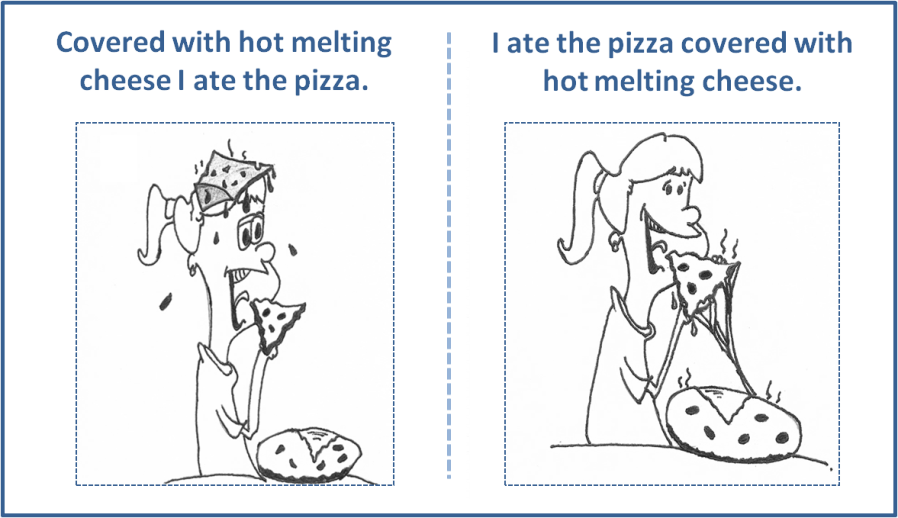
    Misplaced Modifiers can cause considerable confusion to readers and can also be a great source of amusement to them. The error caused by misplaced modifier can be depicted pictorially through many humorous examples. One of them that I use is shown below.
    1. By way of explanation, I use these points:
      • Modifiers are like teenagers – they fall in love with whatever they are next to. Most misplaced modifier errors can be solved by placing the modifier next to the word or group of words that it seeks to modify.
      • In the first sentence, covered with hot melting cheese (the modifier) seeks to modify pizza and not the person eating it. Placing the modifier closer to the word pizza clarifies that the pizza, and not the person eating it, is covered with hot melting cheese.
    2. 2

      Comma In Direct Address

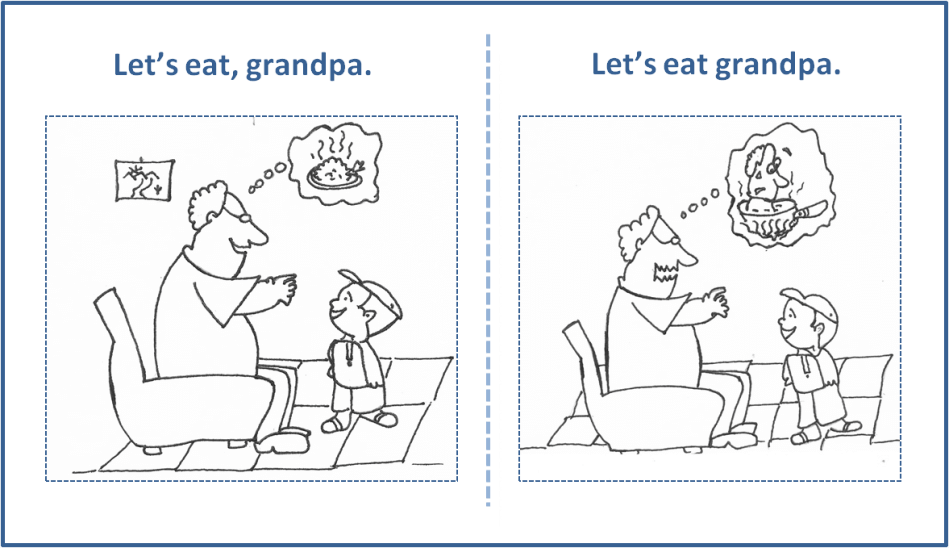
      Not using commas in direct address is a very common error. Students and adults alike commit this mistake. Show them the picture below and they will develop an appreciation of the importance of using commas correctly in direct address.


    1. By way of explanation, I use these points:
      • Placing the comma before grandpa clarifies that the boy is asking his grandpa to eat with him. Without the comma placed before grandpa, it would appear as if the boy wants to eat his grandpa.
      • Commas are used to set off names (or words used in place of names) when addressing people directly in a sentence. The rules for placing commas in direct address are simple.  If the name comes first, it is followed by a comma. Grandpa, I want to eat a truck-load of ice. Sam, I want to eat a truck-load of ice.  If the name comes at the end of the sentence, the comma precedes the name. I want to eat a truck-load of ice, grandpa. I want to eat a truck-load of ice, Sam.  If the name comes in the middle of the sentence, it is surrounded by commas. What I said, grandpa, is that I want to eat a truck-load of ice.What I said, Sam, is that I want to eat a truck-load of ice.
    2. 3

      Your vs. You’re

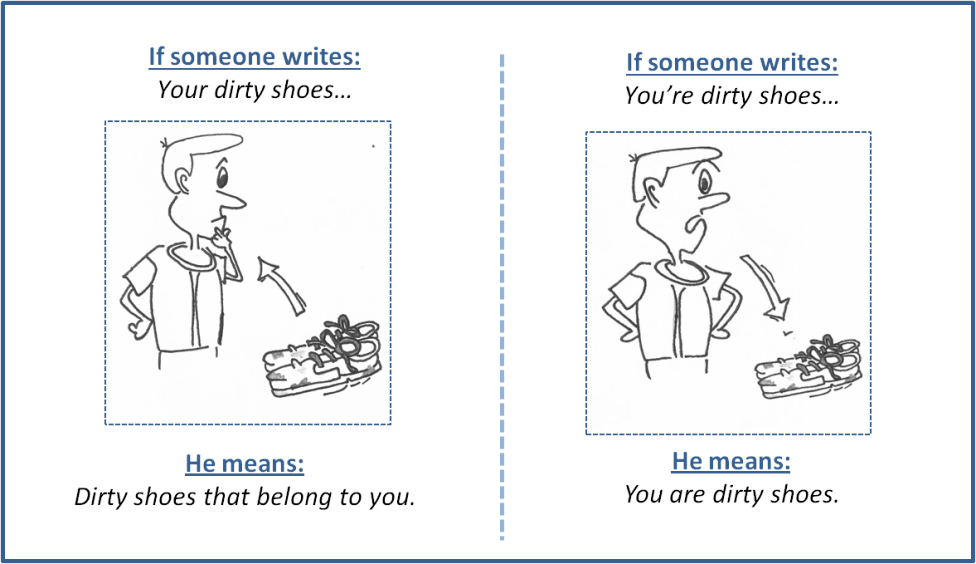
      I have gone through numerous lists of commonly confused words and in almost all of them your / you’re features in the top five. The error could stem in part due to an incorrect understanding of the use of apostrophes in forming contractions. The picture below should help them understand that the two words are different and should not be used interchangeably.

    1. By way of explanation, I use these points:
      • You’re is a contraction of you are.
      • Your shows possession. It means belongs to you.
      • If you are confused on whether to use your or you’re, check if you are fits into the sentence; if it does, use you’re, else use your.
    2. 4

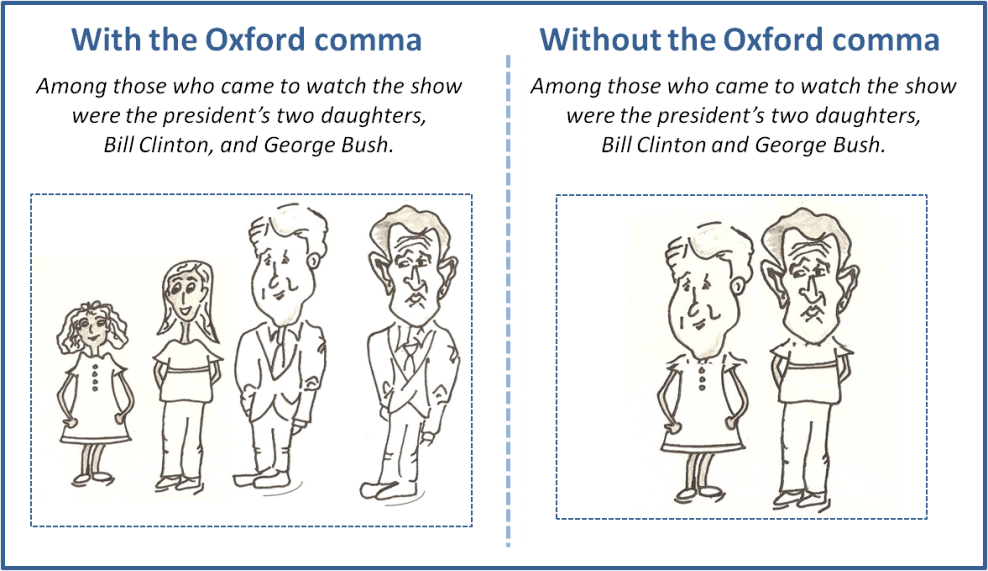
      The Oxford / Serial Comma

      The Oxford comma is a highly-debated topic among grammarians. While some feel that it is not necessary, others argue that leaving it out can cause confusion. If you are from the latter school of thought, then you can use the below picture to explain the rationale of using the comma to your students.

    1. By way of explanation, I use these points:
      • The Oxford comma (also known as serial comma or Harvard comma) is a comma that is used before and/or in a list containing three or more items.
        • I like to eat nails, glass, and shoes.
        • I hate people who do not like to eat nails, glass, or shoes.
      • In some cases, the Oxford comma helps avoid ambiguity in a sentence. In the second sentence of the picture, leaving out the comma before and may lead the reader to infer that Bill Clinton and George Bush are the two daughters of the president!
    2. 5

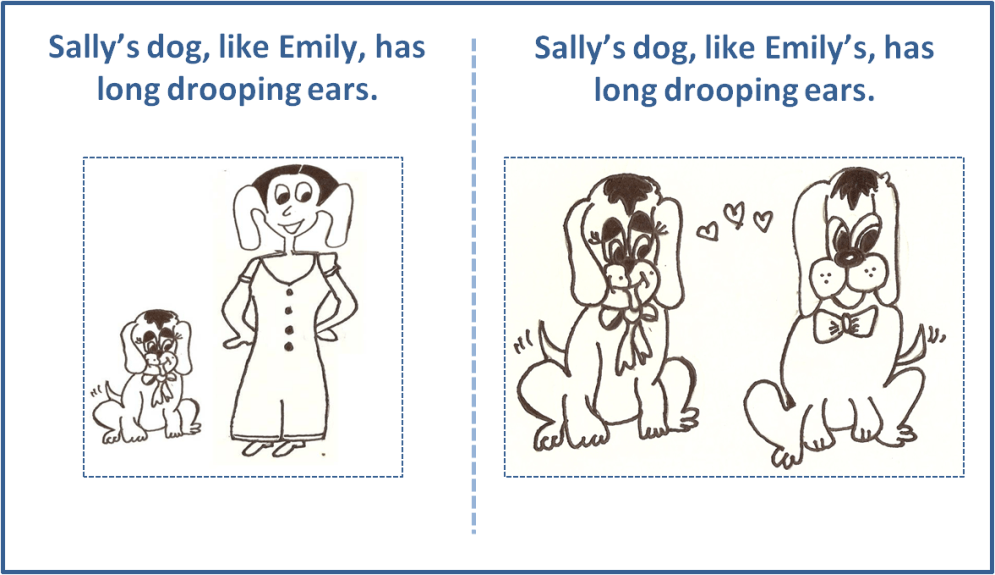
      Faulty Comparisons

      Faulty comparisons occur very frequently in writing. Most people do not even realize that they are comparing two things incorrectly. The picture below shows the confusion and humor that can be caused by faulty comparisons.

    1. By way of explanation, I use these points:
      • Faulty comparisons occur when two things are compared inappropriately or in a way that could confuse readers / listeners.
      • Often, the comparison will sound as though it's acceptable, but will be missing a few necessary words. The shirt you are wearing looks like my brother. Here, the shirt is being compared to the brother and not to the brother’s shirt.  The shirt you are wearing looks like my brother’s.  The shirt you are wearing looks like my brother’s shirt. Both of the above sentences are correct. In the first sentence, although the word shirt isn’t present, adding the ’s after brother implies that we are comparing the shirt belonging to the brother.
    There are several benefits of using pictorial representations for teaching concepts of grammar, punctuation, and word usage.
    • Students appreciate the importance of the concept, as they can clearly see the confusion or humor caused by the error.
    • Pictorial representations create visual reinforcement and can be especially useful for those students who are visual learners. If not anything else, students will remember the picture associated with each grammar lesson.
    • The pictures can provide an element of fun to the learning process and take some of the boredom out of the grammar class.


5 Learning Strategies That Make Students Curious


Understanding where curiosity comes from is the holy grail of education.
Education, of course, is different than learning.
Education implies a formal, systematic, and strategic intent to cause learning. In this case, content to be learned is identified, learning experiences are planned, learning results are assessed, and data from said assessments play some role in the planning of new learning experiences. Learning strategies are applied, and snapshots of understanding are taken as frequently as possible.
This approach is clinical and more than a smidgeon scientific. It arrests emotion and spontaneity in pursuit of planning and precision, a logical trade in the eyes of science.
Of course, very little about learning is scientific. While data, goals, assessment, and planning should all play a role in any system that purports to actually accomplish anything, learning and education are fundamentally different. The former is messy and personal, painful and fantastic. The latter attempts to assimilate the former—or at least streamline it as much as possible in the name of efficiency.
An analogy might help.
learning:education::true love:dating service
True love may very well come from a dating service, and dating services do all they can to make it happen, but in the end—well, there’s a fair bit of hocus pocus at work behind it all.
Hubris and Education
Education is simultaneously the most noble and hubristic of all endeavors. This may all reek of sensationalism, but watch anyone at play, honing a craft, lost in a book, or engaged in a digital simulation and you’ll see a completely different person—one there physically, but far removed in spirit.
In a better place.
Causing this in a classroom is possible, but is as often the result of good fortune than good planning. The best substitutes that can masquerade as curiosity are dutiful compliance and engagement. Neither of these are curiosity, which has among its sources a strong sense of volition, accountability, and curiosity.
Here, let me try.
I want to show you what I can do.
I want to know.
And that last one—a sign of curiosity–is a bugger, one we’ve talked about before. Like the caffeine in coffee, the chords on a guitar, or the wet in water, genuine curiosity is not a thing, it’s the thing.
Not temporarily wanting to know, or being vaguely interested in an answer, but being able to put together past experience and knowledge like the millions of fibers on a network–only to be maddeningly stopped from branching further without understanding or knowing this one bit.
Like stopping an incredible movie right at the climax—that awful, crazy feeling inside would be unfulfilled curiosity—and it’d just kill you not to know. But where does it come from?
And can you consistently cause it in a learner?
If formal learning environments driven by outcomes-based systems have taught us nothing else, it’s that while we often can “cause” something to happen in learner, it is only by considerable effort, resources, and angst.
But we certainly can create ideal conditions where natural curiosity can begin to grow. What we do when it happens—and disrupts our planned lessons and tidy little units—is another story altogether.


5 Things That Make Students Curious
1. Old Questions
The simplest curiosities arise from old questions that were never fully answered, or that no attempt to answer was made.
Of course, any question worth its salt is never “fully answered” any more than a good conversation is ever finished, but as we learn and reflect and grow, old answers can look positively awkward, as they are bound by old knowledge.
Strategy to actuate: Revisit old questions—through a journal prompt, Socrative discussion, QFT (Question Formulation Technique), or even a fishbowl discussion. And also revisit the thinking from the first go-round to see what has changed.
2. Ambition
Ambition precedes curiosity. Without wanting to advance in position, thinking, or design, curiosity is simply a biological and neurological reaction to stimulus. But ambition is what makes us human, and its fraternal twin is curiosity.
Strategy to actuate: Well thought-out mentoring, peer-to-peer modeling, Project-Based Learning and a genuine “need to know.”
3. Play
A learner at play is a signal that there is a comfortable mind focused on a fully-internalized goal. It may or may not be the same goal as those given externally, but play is hypnotic and more efficient than the most well-planned instructional sequence. A learner playing, nearly by definition, is curious about something, or otherwise they’re simply manipulating bits and pieces mindlessly.
Strategy to actuate: Game-Based Learning and learning simulations like Armadillo Run, Fun, Civilization V, Bridge Constructor, and Age of Empires all empower the learner to play. Same with Challenge-Based learning.
4. The Right Collaboration At The Right Time
Seeing what is possible modeled by peers is powerful stuff for learners. Some may not be initially curious about content, but seeing what peers accomplish can be a powerful actuator for curiosity. How did they do this? How might I do what they did in my own way? Which of these ideas I’m seeing are valuable to me—right here, right now–and which are not?
Strategy to actuate: Grouping is not necessarily collaboration. To actuate collaboration, and thus curiosity, students must have a genuine need for another resource, idea, perspective, or something else otherwise not immediately available to them. Cause them to need something, not simply to finish an assignment, but to achieve the goal they set for themselves.
5. Diverse & Unpredictable Content
Diverse content is likely the most accessible pathway to at least a modicum of curiosity from learners. New projects, new games, new novels, new poets, new things to think about.
Strategy to actuate: Invite the learners to understand the need for a resource or bit of content and have them source it. Instant diversity class-wide, and likely divergence from where you were going with it all. At worst you’ve got engaged learners, and a real shot at curiosity.


Individualisation in Language Teaching


This publication provides a useful introduction to innovative approaches to self-directed learning and individualisation: http://englishagenda.britishcouncil.org/milestones/individualisation-language-teaching 


Monday, April 1, 2013

Top Tips for Teaching Practice Part 1


Teaching practice can be a a huge source of anxiety for new teachers who are short on time. This collection of resources was created for new teachers and can help save time when preparing for teaching practice, as well as providing valuable guidance and reference material along the way. These materials contain valuable information for teachers at all stages of their careers, who may be looking for some extra inspiration on learning strategies, assessment and classroom management.

1. Starters

We all know how important having a good ‘starter’ is in lessons. It can serve as that all-important hook for the remainder of the lesson and really help to motivate pupils and stimulate their curiosity. The resources below can provide you with a whole range of interesting starter activities which you can either use directly or adapt to suit your own purposes.

  • A great idea to start a fun class with an Icebreaker.
  • I really like this jigsaw starter activity. Great for the start of the class as students slide into class!
  • The starter powerpoint is excellent. I particularly like the links between the index and the slides.
More Icebreakers:


Hope they work for you! Good luck!


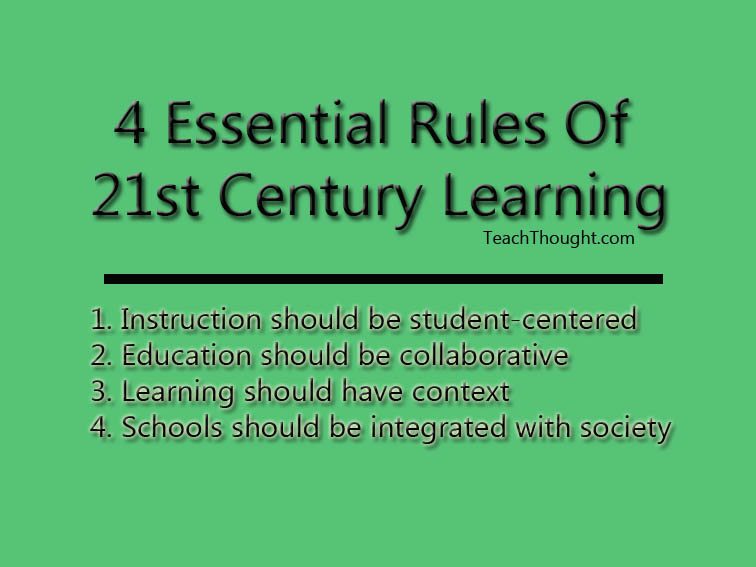
4 Essential Rules Of 21st Century Learning


The term “21st century” has become an integral part of educational thinking and planning for the future. Educators and administrators are actively searching for ways to prepare students for the future, and the educational system has been evolving faster than ever before.

Various studies have shown us that rote memorization is not an effective learning strategy, and that teacher-centered classrooms may not be the most efficiently structured ones for student engagement.

However, despite learning about the skills that students will need to develop to become successful in the 21stcentury, as well as what beliefs about education may be worth hanging onto or throwing away, schools and teachers are left trying to figure out what their role needs to be in the education of their 21st century students.

Once upon a time, the role of the educator was to prepare students for the specific tasks they would be required to complete (be it a trade, craft, or profession). Communities were also much more homogenous, and so specific values and cultures needed to be transmitted and practiced to ensure the survival of those beliefs.

Nowadays, we don’t live in the same world. Society is a mix of many different beliefs and cultures. Globalization has opened up the world and allowed people to connect in new and exciting ways. We blend traditions and create unique belief systems that are not taught in any classroom, but are developed through our life experiences and passions. We transmit our values and cultures without the expectation of them being adopted by our audience – just accepted by them.

So then, what is the role of education in the 21st century?

As always, at its core, the role of education is to prepare students to become active, successful, and contributing members of society. The essence of education’s role has not changed.

However, there has been an important change that must be considered.

Society has changed. We cannot adequately prepare students for the society that exists today or will exist tomorrow, if we continue to prepare them for the society that existed yesterday. In order to prepare students to play their role in the 21st century society we are a part of, a few things need to be considered when deciding how education will look in our schools and classrooms.


1. Instruction should be student-centered
The days of lecturing teachers has passed – though not entirely. While student-centered learning is strongly encouraged in the 21st century, this does not mean that the teacher can never give a lecture again. Instead, it means that the main source of knowledge in the classroom should not be the teacher. Education is no longer about listening to the teacher talk and absorbing the information. In order to contribute to society, students will need to be able to acquire new information as problems arise. Then, they will need to connect the new information with the knowledge they already have and apply it to solving the problem at hand. They will not be able to call upon a teacher for answers, so will need to have ‘learned how to learn’ on their own.

In this classroom model, the teacher would act as a facilitator for the students. Instead of passively receiving information, the students would gather information on their own, under the guidance of their teacher. Different learning styles are encouraged, and students have an enhanced sense of motivation and responsibility. They engage in many different types of hands-on activities, as well as demonstrate learning in many different ways. Learning is about discovery, not the memorization of facts.

2. Education should be collaborative
Students must learn how to collaborate with others. Society today has people collaborating across the globe. How can students be expected to work with people from other cultures, with different values from their own, if they are not able to work with the people they see each day in their classroom?


Students should be encouraged to work together to discover information, piece it together, and construct meaning. Collaboration should also be dynamic. Students should learn how to recognize the different strengths and talents each person can bring to a project, and change roles depending on those attributes.

Schools should also be collaborating with other educational institutions around the world to share information and learn about different practices or methods that have been developed. They should be willing to alter their instructional methods in light of new advancements.


3. Learning should have context
Student-centered does not mean that the teacher gives up all control of the classroom. While students are encouraged to learn in different ways, the teacher still provides guidance as to the skills that need to be acquired. The teacher can make a point of helping students to understand how the skills they are building can be applied in their lives. Students will be much more motivated to learn something that they can see the value in.

Since we are no longer preparing students for specific tasks and roles, we need to take a more general approach and teach them the skills that are useful in any situation. Lessons have little purpose if they do not have any impact in a student’s life outside of the school.


4. Schools should be integrated with society

In order to prepare students to become responsible citizens, we need to model what a responsible citizen is.


Schools will often work at accomplishing this by creating events for the school community, by encouraging students to join committees or take part in school projects, and by occasionally helping the community around them with activities such as food drives or neighborhood clean-ups.

With the powers of technology and the internet, students of today can do even more. Our community is no longer just the area of space located around the school, but reaches out and envelopes the world.

Education needs to help students take part in this global community and find ways of impacting more than just their neighborhood. This doesn’t mean that they do not need to learn the value of helping others around them and protecting their immediate environment, but that they should also be learning about how they can help and protect a world further away from them, but also closer all the time.


Saturday, March 30, 2013

FORUM English Teaching Magazine


Here´s a great English Teaching Magazine: FORUM! Which is now in American English, read Volume 51 here:

English Teaching Forum 2013, Volume 51, Number 1

Payback Time: Lessons From The Harshest Teacher Trainers (My Students!)


I found this interesting and very brave post on the internet, hope it can help you as it´s going to help me in my teaching practice.


Students, the harshest teacher trainers?
This semester I decided to compile as much data as possible from my students and co-teachers regarding my performance and effectiveness over the past four months. The results have been invaluable as a tool for my own professional development, but I also believe that, despite the variation in contexts, they can provide some useful tips and insight for other educators too. Here are my reflections on the feedback I received and the lessons I've learnt.

I've embedded the full document with my students and co-teachers feedback at the bottom of the blog.

My Reflections

The feedback from both my students and co-teachers has been unexpectedly positive, my co-teachers have enjoyed being a part of the lessons and my students seem to have really appreciated the structure of the lessons and my passion for their education. I've been overwhelmed by how constructive (both critically and favourably) and honest their feedback has been, it has provided me with an invaluable opportunity to improve as a teacher.

I’m going to split my reflections into three sections: firstly, I’ll look at things I need to keep doing (that I have started doing and have worked well), secondly, I’m going to consider things I need to start doing and finally, things I need to stop doing!

Things I Need to Keep Doing (I’m going to concentrate here on things I don’t feel I did so well in previous semesters.)

i) Use of Short Films

The student response to the use of short films in class (usually between 1 minute and 10 minutes in length) indicates that students are really enjoying them, that they are seeing the benefit of them and that they have been extremely important a motivating and holding the concentration of my students. I think there are a number of reasons for this:

1) Teenagers now live in a much more visually stimulating world. Everything is on computers or T.V’s, and this is what the students are used to.

2) Some of my classes are very mixed ability. Short films allow my low level students to understand the general gist of what is happening, the information they get visually can help them understand and contextualize the language that is being taught. For my highest level students videos often come with very natural pronunciation and expressions, this presents a great opportunity for them to hear language how it is naturally used and challenges them to pick out language and expressions they wouldn't find in a text book.

3) Videos allow students to absorb culture as well as language. I find my students genuinely interested in other cultures around the world and video present a great way for them to explore that.

ii) Praising the Students and Displaying Their Work

It has really become apparent to me this year just how important praise is to the students. My girl classes visually show how much they want positive feedback and so it is easy to find opportunities to provide them with positive feedback and praise. At this age boys can’t really be seen to desire positive feedback from the teacher, I think this is especially apparent if the teacher is male. This means it is harder to find opportunities to provide them with positive praise and feedback. From the student feedback it seems I have done this successfully with my first grade boy classes, but not my second grade boy classes. The classes are much larger and the boys are naturally much louder and more boisterous, so it is harder to find opportunities. Next semester I really need to actively find opportunities to provide them with positive feedback.

We’ve done two activities this semester purposely designed to give the students opportunities to make some really great work that can be displayed all over the class. The feedback shows the students have both acknowledged and appreciated this. Other than this feedback I have noticed the students really taking a keen interest in other classes’ work that is displayed around the room. It seems to have created a kind of competition between the classes.

iii) Having Clear Rules

Although I have the same rules this semester as last semester, I am working at a different school that provides more levels of support when enforcing rules. This semester has shown just how important the support of the institution is in enforcing rules. As an example, last year if a student walked into class 5 minutes late eating cake nothing was done about it, although I disciplined them, the institution itself took no interest in this. This semester there are clear consequences, both from myself and the institution, regarding the consequences of a student’s actions. It has become very clear how important having your institution on your side regarding discipline is.

iv) Catering to Multiple Intelligences & Learning Styles

Something that has been made absolutely clear in the feedback from the students is the variety of learning styles and preferences the students have. The students indicated that they recognized the use of many different forms of activities, but when asked what they would like more/less of next semester and what they enjoyed/didn’t enjoy, other than wanting more short films, there was a huge variation. For me, this clearly shows the importance of providing students with a range of activities and stimuli in order to keep all students motivated and interested in class.

Things I Need to Start Doing

i) Giving Students More Time to Complete Activities

Although the students rated me favorably for this it was still one of my lowest scores, and I have to say that on reflection I absolutely agree with them. For the majority of the semester I was at conflict with my institution. They wanted me to teach key expressions every class, I wanted to teach skills. This meant I was trying to fit both into a 50 minute period and the classes felt a bit too rushed. I’ve now reached a compromise with my school; we are going to have spread topics over two classes, meaning half the compulsory amount of expressions and more time for skills. This will hopefully result in the classes being less rushed. It’s amazing just how observant and sensitive the students are to issues such as this.

ii) A Better Introductory Lesson

I started at a new school this semester and my directives were to start teaching my syllabus from the very first class. They asked me to only take up 10 minutes for introductions etc. and I used this time for making the rules of the classroom clear and introducing myself. I think this was a mistake and something I should have strongly objected to. The students have shown in their feedback that they weren’t sure exactly what they were supposed to achieve from the course, something that should have been made clear to them in the introductory lesson. Although almost all the classes adapted well I think this could be partially responsible for the behavioral problems one class faced at the beginning of the semester. Quite simply they weren’t sure why they were there. This is a mistake I won’t be making again.

iii) Explaining the Reason behind Activities

On reflection something I hardly did this semester is tell students why we were doing the activities we were doing, what skills were we practicing, what could they achieve from the activity, how is it useful for them in real life etc. This is shown in the relatively low score for ‘providing students with opportunities to practice creative thinking, divergent thinking and critical thinking’. Although I strongly believe these skills were practiced in almost every class I didn’t make the students aware of this. This is definitely something for me to bear in mind next semester.

Things I Need to Stop Doing


i) Compulsory Homework

Feedback from the students is quite clearly against homework, and on reflection I think they might be right!

Why am I giving them homework? The honest answer is ‘I’m not sure.’ Maybe because it’s what my teacher did when I was at school, maybe because I want them to see my class is serious, maybe it just felt right.

What did I achieve from it? Probably not much, the students who wanted to do it did it, and I hope gained from it (it was usually to interview someone, in English, on the topic we had done in class), but by forcing students to do it who didn’t want to meant that all they were probably doing was either copying their friends answers or making it up. Next semester I will make students aware of the reasons for doing the homework, but make it optional. This will also mean I have fewer to grade and so can do a more thorough job.

ii) Presuming I Can Motivate 2nd Grade Boys with Stamp Sheets!

The 2nd grade boys have made it very clear to me this semester they really don’t care about stamp sheets (a technique that works very well with my other classes). So, I’m going to have to think of something new, something sports related. At this point I’m not sure what, but I have a month to figure it out! For me this was a really clear reminder that we teach students, not lessons, and all students have different needs we must adapt to.

Notes

i) This is the first time I have performed such an extensive self evaluation and the amount I have learnt from it has been invaluable. I wasn’t required to do it by my school or regional office, and it took a lot of time to put together all the data, but I highly recommend doing it. The main reasons I have never done this before is firstly, because I’ve never been required to do it, and secondly, because I was nervous that the feedback might be negative. However, I really encourage teachers to do this once or twice a year as you will be surprised how much you will learn, both about what your co-workers and students appreciate in your work, and what you can improve. In terms of professional development, it seems essential.

ii) The low score for the ‘level of the exam was appropriate’ is something I haven’t mentioned as it is not something I had much (or any) control over. The results of that question have been fed back to the institution I work and it is something that we are going to work closer together on next semester to rectify.


If you took the time to read this I really hope it was useful for you. I would love to hear any comments regarding these reflections, especially if you've got any tips for motivation 40+ 17 year old boys ;-)


Monday, March 25, 2013

Tools to build vocabulary


Learning and most of all, acquiring new vocabulary is a matter of obsession for both, English Language Learners and Educators, here I share with you some useful strategies to help you deal with this matter.


How do you record new words? Do you use mind maps? Tables? Flash cards? Or some other way? Check out these tips and practice exercises to help you choose the best way for you! 

Word cards: http://learnenglishteens.britishcouncil.org/exams/exam-grammar-vocabulary/word-cards
Mind maps: http://learnenglishteens.britishcouncil.org/exams/exam-grammar-vocabulary/mind-maps
Tables: http://learnenglishteens.britishcouncil.org/exams/exam-grammar-vocabulary/tables

Monday, September 10, 2012


Hello fellow PNIEB teacher, here are some easy steps to correctly plan your social practice, let´s begin:

1. Identify the product for your specific competency
2. Identify the achievements for your specific competency. 

3. Analyze how these achievements are related with the product and the specific competency. 


Tip: The achievement must always be present and will be reviewed at different moments. 

4. Analyze the suggested product stages for your specific competency in the syllabus

a. Identify the opening, development and closure stages.

5. Select and write on separate pieces of paper the stages that will be used in your team’s planning. From the suggested stages, some may be eliminated, or additional stages can be included.

You should have at least 3 main moments: 

Initial

Development

Closing 

6. Review the contents for the unit being planned and relate them to the different project stages.

7. Identify which contents are necessary for the initial, development and closing stages of the development of the product. 

Contents may be repeated

8. Answer the following four questions:

Is the relationship between the product and the specific competency clear?

Do the stages on your plan guarantee the elaboration of the product and the development of the specific competency?

Are the three types of content articulated in the different stages?

Will the achievements be reached with this plan?

9. Decide how long the development of the product will take. 

10. Assign times to each product stage

11. Choose one of the stages of the product development to be designed.

12. Brainstorm different activities (communicative situations) that could be carried out to work on this stage of the product. 

Write a list of possible activities.

13. Plan a Stage.

14. Consider the following elements and write them on a sheet of paper: 

Clarify the purpose of this stage.

Determine the logical sequence of activities and the time for it.

Identify assessment methods.

15. Determine the final activities in your classroom.


<script type="text/javascript" src="http://www.taggify.net/va/view.ashx?key=3514d9b7ea094ff984ff544d524a63dd&country=&tzo=-7&chn=704&min_w=200&min_h=150&auto_tlt=EFEFEF&auto_txt=A2A2A2&auto_price=3399CC&auto_img_brd=D8D8D8&auto_bg=000000&auto_transp=85&auto_side=btm&cref=18,13,85,53,128,135,142,20,147&auto_ro=1&auto_show=1&no_roll=0&auto_types=inbar,indisp,cute&no_textify=0&txf_tlt=990000&txf_txt=000000&txf_price=336600&txf_bg=FFFFCC&txf_hl_txt=FFFF99&txf_hl_bg=CC0000&txf_max_i=10&txf_max_w=5" language="javascript" charset="utf-8"></script> 

Friday, March 30, 2012

Teacher Christian P. Hndez.: Guidelines for new (and not so new) teachers Part ...

Teacher Christian P. Hndez.: Guidelines for new (and not so new) teachers Part ...: One of the most significant things you can do to affect student conduct is to establish effective daily events in your classroom. Doing s...


<script type="text/javascript" src="http://www.taggify.net/va/view.ashx?key=3514d9b7ea094ff984ff544d524a63dd&country=&tzo=-7&chn=704&min_w=200&min_h=150&auto_tlt=EFEFEF&auto_txt=A2A2A2&auto_price=3399CC&auto_img_brd=D8D8D8&auto_bg=000000&auto_transp=85&auto_side=btm&cref=18,13,85,53,128,135,142,20,147&auto_ro=1&auto_show=1&no_roll=0&auto_types=inbar,indisp,cute&no_textify=0&txf_tlt=990000&txf_txt=000000&txf_price=336600&txf_bg=FFFFCC&txf_hl_txt=FFFF99&txf_hl_bg=CC0000&txf_max_i=10&txf_max_w=5" language="javascript" charset="utf-8"></script> 

Guidelines for new (and not so new) teachers Part 1


One of the most significant things you can do to affect student conduct is to establish effective daily events in your classroom. Doing so will allow you to be organized and appear in control. It will also allow students to take responsibility for themselves because they will know what to do. Time is also used more effectively in classrooms with established daily procedures. The tips that follow offer suggestions that will help you establish effective daily procedures in your classroom.

What You Should Do:
Set up procedures for the following classroom activities:

  • Entering the classroom
  • Taking roll
  • Dealing with tardy students 
  • Dealing with students who lack materials 
  • Labeling student papers 
  • Preparing to leave at the end of class 


  How To Do It: 

Entering the Classroom 
Begin each lesson with a brief warm-up or ice breaker activity such as a game, vocabulary review, etc, in the following link you can find many warm-ups or ice breaker activities to use in your classes:
Warm-ups and Icebreakers for classroom games and activities

Before students arrive, post the warm-up activity on the board and make a list of the materials needed for the lesson. If there is a new homework assignment, post it on the board, too. If necessary, remind students to sit in their assigned seats. It may be helpful (and even necessary) to attribute a small portion of a daily grade to these warm-up exercises, you can then include it as a participation grade, but being a fun, short and interactive activity, everyone would be delighted and eager to participate.

Taking Roll
Use a quick method of taking roll as students participate in the opening activity or as they turn in their homework. On the first day of school, set up a seating chart, which you can use to support the students in sitting in their assigned seats. Throughout the year, use the chart to take roll quickly. If students say someone is not absent, but the student is not in the room, simply state that to be considered present a person needs to be working or sitting down when the bell rings or when you enter the classroom.

Dealing with Tardy Students 
Have a plan for dealing with tardy students. An alternative would be to allow a small interruption, quickly update your attendance sheet and move on. Be sure to point out to the tardy student the consequence of habitual tardiness. You may be able to prevent a majority of late students by holding them accountable for lateness. For example, you might dock a student's participation grade by half a point for every three times tardy.

Dealing with Students Who Lack Materials
If you are unable to get extra copies of your books, have students who arrive without their book share with classmates whom you designate. But not bringing the school materials should have a consequence; permitting students get by without the required materials might send the signal that it is okay to leave materials at home.

Labeling Student Papers
Ask students to write their name, the date, your name, the period number, and the assignment on every paper they turn in to you. You will probably need to remind students of this often. Don´t accept any unlabeled paper, returning it immediately to the student that turned it to you and asking him to write the proper information. Explain that if you cannot determine to whom a paper belongs or which assignment it might be, you cannot give credit for the work.

Preparing to Leave at the End of Class
Everything that has a beginning should have an end to be complete, have a signal for when students may prepare to wrap up the class. For most students, the bell means it is time to drop everything, stuff it all in their backpacks, and leave or wait for their next class, lunch, or home. You can ask students not to leave until you have signaled that class is over. Request that they not pick up their backpacks or other bags until they are dismissed. Allow time for closure and clarification of assignments. Then give your dismissal signal. Try always to include a game, a song, an activity which is fun, short and interactive as a wrap-up to leave them craving for more, but also that has something to do with the day´s lesson.

To be continued………………………

 If you have any comments or more ideas on this topics, please share your insights and knowledge!


<script type="text/javascript" src="http://www.taggify.net/va/view.ashx?key=3514d9b7ea094ff984ff544d524a63dd&country=&tzo=-7&chn=704&min_w=200&min_h=150&auto_tlt=EFEFEF&auto_txt=A2A2A2&auto_price=3399CC&auto_img_brd=D8D8D8&auto_bg=000000&auto_transp=85&auto_side=btm&cref=18,13,85,53,128,135,142,20,147&auto_ro=1&auto_show=1&no_roll=0&auto_types=inbar,indisp,cute&no_textify=0&txf_tlt=990000&txf_txt=000000&txf_price=336600&txf_bg=FFFFCC&txf_hl_txt=FFFF99&txf_hl_bg=CC0000&txf_max_i=10&txf_max_w=5" language="javascript" charset="utf-8"></script>